
Centre For Local Research into Public Space (CELOS)



 Show search options


 You are on the [cover page] of folder [Research Library ]
Research Library




Financial Records
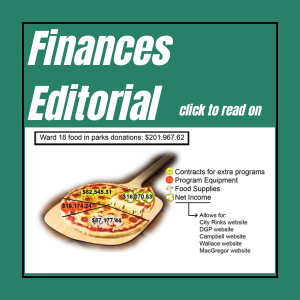
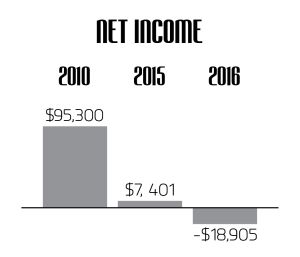
Numbers tell a story, although never the whole story. Here's part of the Dufferin Grove story, in the September 2015 newsletter version: the money story.
Here's a comparison of net cost, income and expenses for Dufferin Grove, 2011 to 2018.
The other thing about numbers is they're slippery things and it's easy to make arithmetic and data entry mistakes. The reader will find such mistakes in both the CELOS reports and the City of Toronto reports. If you find more mistakes, that we haven't pointed out already, please tell us at mail@celos.ca. Or tell the city at 311. Or both!
Despite the mistakes, there are patterns that can help teach what works and what doesn't. For 19 years, CELOS and city recreation staff collaborated closely. The follow-up -- what happened when the collaboration stopped -- makes an interesting story too. That's why we've kept on posting the City of Toronto financial records about Dufferin Grove/Ward 18 as well as those of CELOS.
Yearly financial reports

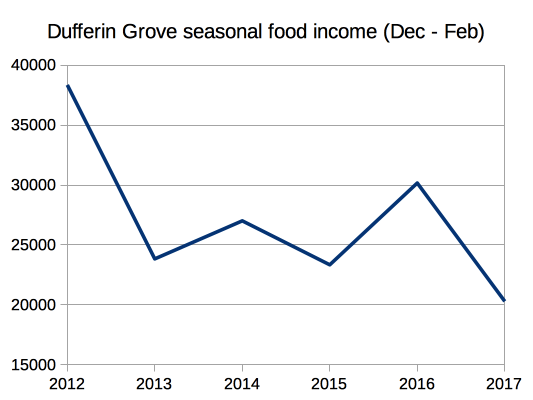
Read more about Dufferin Grove income trends here.
Comparisons of Dufferin Grove operating costs over time:
- Dufferin Grove rink clubhouse maintenance costs 2012 - 2017
- comparison of Dec/Jan/Feb rink season income Dec.2011 – Feb.2017
- Activity highlights of CELOS/City collaboration, 1992 to 2012
- comparative income chart, Friday Night Supper 2011 - 2015
- City of Toronto Pcard purchases for Dufferin Grove Park programs, 2011 to 2016
- City of Toronto food purchase orders for Dufferin Grove Park, 2013 to 2017
- Bread income 2008 to 2018
More stories, beyond what money can show: here and here
August 8, 2007 letter to the PFR internal auditor
Resources:
City of Toronto part-time recreation staff sample wages
Budgetpedia.ca on the PFR budget 2017
see also Website Usage
Publications
Disseminating information about public space
For our current set of publishing activities, see
- CELOS Booklets
- CELOS Information Bulletins
- CELOS Speakers' Series
- CELOS Reports
- CELOS Slide Shows
- CELOS Videos
- CELOS book draft, 2016
Friends of Dufferin Grove Park began a monthly newsletter in September 2000, which has been published by CELOS since 2003. CELOS also distributes a weekly web newsletter about the Dufferin Park Farmers' market, and an occasional e-newsletter about Toronto city rinks.
This is an historical ARCHIVE
Permits
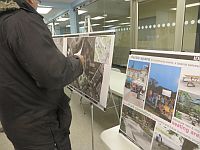
Community Consultation
Here is a picture showabout the unmaking' of Dufferin Grove Park.'
The 2010 report by Dave Harvy and (Toronto Park People), funded by the Metcalf Foundation Fertile Ground for New Thinking Dave's concludes that it's time for Torontonians involved with parks to join their voices in bringing about park improvements.
You can find out about the Recreation Service Plan by going to this city webpage. You can find out how the consultations were set up by looking at this staff report.
Here is the City's list of "stakeholders" who were contacted to give their opinions about the Recreation Service Plan in May and June, 2011 (and the Parks Plan in September 2011). Here's the city's stakeholder list with contact links. If your "park friends" or advisory group is not on the list of groups who will be asked for their views, you can e-mail 311@toronto.ca and ask them to help you get on it.
Notes on the public consultation sessions:
consultation reports. CONTENT DELETED BY CITY STAFF